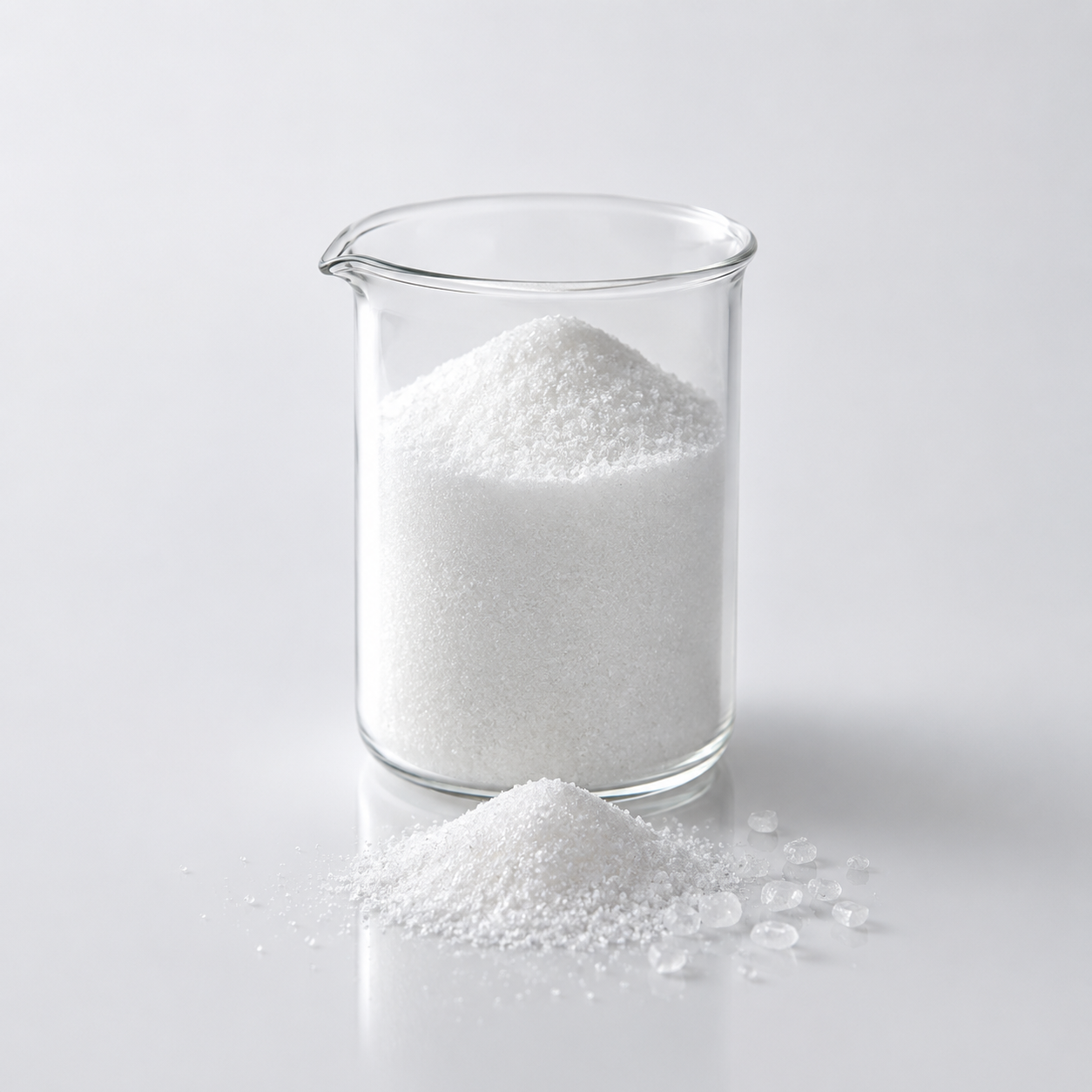
Glass beaker filled with white granulated sugar, with loose crystals spilled on the surface in front of it.

The Beauty & Personal Care Brand Builder Series

Sodium Benzoate

Glass beaker filled with white granulated sugar, with loose crystals spilled on the surface in front of it.

The Beauty & Personal Care Brand Builder Series

Sodium Benzoate

A Globally Trusted Preservative for Water-Based Cosmetics

Sodium Benzoate is the sodium salt of benzoic acid and one of the most widely used preservatives in cosmetics, foods, and pharmaceuticals. Because it is roughly 200 times more water-soluble than benzoic acid itself, it is the practical, formulator-friendly way to deliver benzoic acid’s antimicrobial protection into water-containing products.

Approved across major markets — FDA GRAS for food, EU Annex V for cosmetics, and reviewed as safe by the Cosmetic Ingredient Review — Sodium Benzoate has become a mainstay of clean-leaning, paraben-free formulating. It is most effective in acidic systems, where it converts to its active form to guard against yeast, mold, and bacterial spoilage.

Image shows FormuNova Icon in Blue

GOOD

Preservative

Functions as a preservative (antimicrobial), protecting water-containing formulations from yeast, mold, and bacterial spoilage. Its activity is pH-dependent and strongest in acidic systems (optimal below roughly pH 5), so it is used in low-pH products and frequently paired with potassium sorbate for broader, more robust preservation.

Commonly used in shampoos, conditioners, micellar waters, facial cleansers, toners, and acidic serums and essences — essentially any water-containing formula held at a low pH.

Ideal for brands formulating water-based or acidic products — shampoos, cleansers, toners, micellar waters, and serums — who need a globally approved, cost-effective, paraben-free preservative. Especially suited to clean-positioned lines seeking a well-recognized alternative to parabens and formaldehyde-releasers.

Benzoic acid, sodium salt, Sodium salt of benzoic acid, Benzoate of soda, E211, Natrium benzoate

Private Label Formulas

🇺🇸 MADE IN USA | 🚀 READY TO LAUNCH

Benefits of Sodium Benzoate


Sodium Benzoate combines reliable preservation with broad regulatory acceptance, making it a versatile, formulator-friendly addition to water-based cosmetics.

  • Effective antimicrobial protection: Particularly strong against yeasts and molds, helping prevent spoilage and extend shelf life.

  • High water solubility: Roughly 200 times more soluble than benzoic acid, so it disperses easily into the water phase.

  • Globally approved and well-characterized: FDA GRAS for food, permitted under EU Annex V for cosmetics, and reviewed as safe by the CIR Expert Panel.

  • Paraben-free preservation: A widely accepted choice for clean-positioned and natural-leaning product lines.

  • Cost-effective and synergistic: Works well alongside potassium sorbate and chelators for broader, more robust preservation.

Common Applications of Sodium Benzoate


Sodium Benzoate is used across a wide range of rinse-off and low-pH leave-on formats where reliable, paraben-free preservation is needed.

  • Hair care: Shampoos and conditioners.

  • Facial care: Micellar waters, facial cleansers, toners, and acidic serums and essences.

Formulation Considerations


Because only undissociated benzoic acid is antimicrobially active, Sodium Benzoate must be formulated at low pH — generally below 5, with efficacy rising sharply toward pH 3 — and is commonly paired with potassium sorbate to broaden coverage. Formulators should also note that it can react with ascorbic acid (vitamin C) under heat, light, and trace-metal catalysis to form low levels of benzene; this is readily controlled by keeping pH at or above 3, limiting heat and UV exposure, adding a chelator such as EDTA together with an antioxidant, or avoiding the high-benzoate plus high-vitamin-C combination.


Reference 1, Reference 5, Reference 6

Safety Analysis

Sodium Benzoate is one of the best-characterized preservatives available. The FDA affirms it as GRAS for food (21 CFR 184.1733); the EU permits it as a cosmetic preservative under Annex V — up to 2.5% (as benzoic acid) in rinse-off products, 1.7% in oral care, and 0.5% in leave-on products; and the Cosmetic Ingredient Review (CIR) Expert Panel concluded it is safe as used in current practices of concentration. It is non-genotoxic, non-carcinogenic, and not a reproductive or developmental toxicant, with low irritation and sensitization potential at typical cosmetic use levels (around 0.1-0.5%). Rare non-immunologic (“pseudo-allergic”) contact reactions can occur, more often in individuals prone to urticaria. The main formulation caveat is its potential to form trace benzene in the presence of ascorbic acid under heat and light, which is avoidable through standard formulation controls (low pH, chelation, antioxidant, and protection from light and heat).

Ready to scale your next production run?

US-based private label, custom formulation, and contract manufacturing — GMP-certified and built to scale. We help established brands differentiate, reformulate, and secure reliable supply.

Explore product launch options for your brand today.

Made in USA
Made in USA

Building something with this ingredient? We formulate and manufacture custom products for brands scaling in beauty and personal care. Explore our product development capabilities.

Private Label Formulas

View All

Macro close-up of clear cosmetic serum or essence with visible air bubbles. Ideal for beauty branding, cosmetic ads, skincare ingredient design, or clean and minimal product presentations.